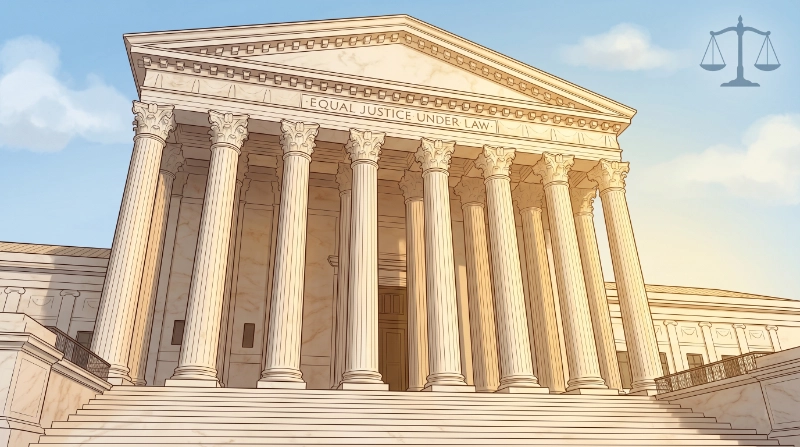
The U.S. court system has multiple levels, with the Supreme Court at the top. The Supreme Court has 9 justices (1 Chief Justice + 8 Associate Justices) who serve for life. Below the Supreme Court are 13 federal Courts of Appeals and 94 federal District Courts.
Key facts:
- 9 Supreme Court justices — appointed for life
- Justices are nominated by the President and confirmed by the Senate
- Supreme Court is the highest court in the United States
- Has the power of judicial review — can strike down unconstitutional laws
- Federal courts hear cases involving federal law, Constitution, and disputes between states
- The judicial branch interprets laws but does not make or enforce them
How the Federal Court System Works
The federal court system has three levels:
- District Courts — trial courts where cases begin. There are 94 district courts across the country.
- Courts of Appeals (Circuit Courts) — 13 appellate courts that review decisions from district courts.
- The Supreme Court — the final authority. Its decisions are final and cannot be appealed.
Most legal disputes start in state courts. Federal courts handle cases involving:
- Federal laws
- The Constitution
- Disputes between states
- Cases involving ambassadors or foreign officials
The Supreme Court
The Supreme Court is the most important court in the country. Key facts:
| Fact | Detail |
|---|---|
| Number of justices | 9 |
| Top justice | Chief Justice |
| Appointed by | The President |
| Confirmed by | The Senate |
| Term length | Life (no fixed term) |
The 9 justices include 1 Chief Justice and 8 Associate Justices. They serve until they retire, resign, or pass away. This lifetime appointment is meant to keep judges independent from political pressure.
Judicial Review
The most important power of the Supreme Court is judicial review — the ability to determine whether a law or government action violates the Constitution. If the Court finds a law unconstitutional, that law is struck down.
This power was established in Marbury v. Madison (1803), one of the most significant cases in American legal history. Chief Justice John Marshall declared that the Constitution is the supreme law and that the courts have the duty to enforce it.
Judicial review is the main check the judicial branch has on the other two branches. It means that even laws passed by Congress and signed by the President can be overturned if they violate the Constitution.
How Justices Are Selected
- When a vacancy opens (through retirement, death, or resignation), the President nominates a replacement
- The Senate Judiciary Committee holds hearings
- The full Senate votes to confirm or reject the nominee
- If confirmed, the justice serves for life
This process can be highly political because Supreme Court decisions shape American law for decades.
What Kinds of Cases Does the Supreme Court Hear?
The Supreme Court chooses which cases to hear — typically about 75-80 cases per year out of thousands of requests. They focus on:
- Cases where lower courts disagree on how to interpret a law
- Cases involving important constitutional questions
- Cases where a federal or state law may violate the Constitution
When the Supreme Court makes a decision, it becomes the law of the land. All lower courts must follow it.
Landmark Supreme Court Cases
While the citizenship test does not ask about specific cases, understanding a few helps explain why the Court matters:
- Marbury v. Madison (1803) — established judicial review
- Brown v. Board of Education (1954) — declared school segregation unconstitutional
- Miranda v. Arizona (1966) — established the right to be informed of your rights upon arrest
How Many Supreme Courts Are There in the United States?
Answer first: there is one Supreme Court of the United States — the federal Supreme Court in Washington, D.C. — and it is the highest court in the United States. The confusion comes from the fact that each of the 50 states also has its own highest court, and most states call theirs a "supreme court" too. So while there are dozens of state supreme courts, there is only one U.S. Supreme Court, and it sits above every other court in the country on questions of federal and constitutional law.
Here is how the layers fit together:
- State supreme courts (50+) — the final word on questions of state law. A state supreme court's ruling is final unless the case raises a federal or constitutional question.
- Federal Courts of Appeals (13) — review decisions from the 94 federal district courts.
- The Supreme Court of the United States (1) — the single highest court in the nation. Its decisions are final and cannot be appealed.
When the USCIS officer asks "What is the highest court in the United States?", the accepted answer is simply the Supreme Court — meaning the U.S. Supreme Court, not a state one. It has nine justices, including the Chief Justice, and it has the final say on whether a law follows the Constitution through its power of judicial review. To lock these answers in, practice them in our free 10-question demo or review how the courts fit into the three branches of government.
Test Questions About the Courts
Q: What does the judicial branch do? A: Reviews laws / explains laws / resolves disputes / decides if a law goes against the Constitution
Q: What is the highest court in the United States? A: The Supreme Court
Q: How many justices are on the Supreme Court? A: 9
Q: Who is the Chief Justice of the United States now? A: (Check current)
Q: Under our Constitution, some powers belong to the federal government. Name one. A: To declare war / to create an army / to make treaties / (and others)
Frequently Asked Questions
How many justices are on the Supreme Court?
There are 9 justices on the U.S. Supreme Court — one Chief Justice and eight Associate Justices. They serve for life or until they choose to retire.
Who is the Chief Justice of the United States?
The Chief Justice leads the Supreme Court and presides over presidential impeachment trials. The current Chief Justice's name may change over time — verify at uscis.gov before your interview.
What is judicial review?
Judicial review is the Supreme Court's power to declare laws or government actions unconstitutional. This power was established in the 1803 case Marbury v. Madison.
How do justices get on the Supreme Court?
The President nominates a justice, and the Senate must confirm them with a majority vote. Once confirmed, justices serve for life or until they choose to retire.
What does the judicial branch do?
The judicial branch interprets laws, decides if laws follow the Constitution, and resolves legal disputes. It is the third branch of the U.S. government, alongside the legislative (Congress) and executive (President) branches.
Why do Supreme Court justices serve for life?
Lifetime appointments are designed to keep justices independent of political pressure. They cannot be fired for unpopular decisions, only removed through impeachment for misconduct.
What is the highest court in the United States?
The U.S. Supreme Court is the highest court in the United States. Its decisions are final — no other court can overrule them. The Supreme Court has 9 justices (1 Chief Justice and 8 Associate Justices) and is headquartered in Washington, D.C.
Is the Supreme Court the highest court in the nation?
Yes. The Supreme Court of the United States is the highest court in the nation, set by Article III of the Constitution. It sits above all federal appeals courts and all state supreme courts on questions of federal and constitutional law. A ruling by the U.S. Supreme Court is the final word on a case.
Why is the Supreme Court the highest court?
The Constitution itself (Article III, Section 1) creates the Supreme Court and gives it final authority over interpreting federal law and the Constitution. Through judicial review, the Supreme Court can strike down laws — even those passed by Congress and signed by the President — if they violate the Constitution. That power, plus its position as the final court of appeal, makes it the highest court.
Key Takeaways
- The judicial branch interprets laws and decides if they are constitutional
- The Supreme Court is the highest court — 9 justices, appointed for life
- Judicial review = the power to strike down unconstitutional laws
- Justices are nominated by the President and confirmed by the Senate
- Supreme Court decisions are final — no higher court to appeal to
- Know the current Chief Justice by name