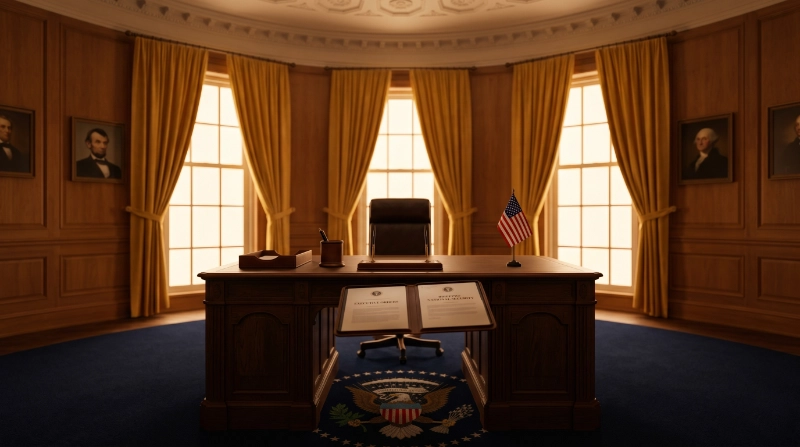
The President of the United States has three primary roles: head of the executive branch, Commander in Chief of the U.S. military, and head of state for the nation. Presidents are elected to 4-year terms and can serve a maximum of two terms (8 years) under the 22nd Amendment.
Key powers and facts:
- 4-year term, maximum 2 terms (8 years total)
- Commander in Chief of the U.S. armed forces
- Signs bills into law or vetoes them
- Appoints federal judges, Cabinet members, and ambassadors
- Negotiates treaties (with Senate approval)
- Issues executive orders to direct the executive branch
The Role of the President
The President's core job is to enforce and execute the laws that Congress passes. While Congress makes the laws, the President makes sure they are carried out.
Beyond that, the President has several specific powers:
Signs or Vetoes Laws
When Congress passes a bill, the President can:
- Sign it — the bill becomes law
- Veto it — the bill is rejected and sent back to Congress
Congress can override a veto with a two-thirds vote in both chambers, but this is rare.
Commander in Chief
The President is the Commander in Chief of the military — the Army, Navy, Air Force, Marines, and Coast Guard all answer to the President. However, only Congress has the power to officially declare war.
Negotiates Treaties
The President negotiates agreements with other countries. Treaties must be approved by the Senate with a two-thirds vote.
Nominates Judges and Officials
The President nominates:
- Supreme Court justices
- Federal judges
- Cabinet members (heads of executive departments)
- Ambassadors
All must be confirmed by the Senate.
The Cabinet
The Cabinet is a group of advisors who lead the 15 executive departments — State, Treasury, Defense, Justice, Education, and others. The Vice President is also part of the Cabinet.
Cabinet members advise the President on issues within their area. The Secretary of State advises on foreign policy. The Secretary of the Treasury advises on economic matters. And so on.
How the President Is Elected
- The President is elected every 4 years in November
- A President can serve a maximum of 2 terms (8 years total)
- The minimum age to be President is 35 years old
- Must be a natural born citizen of the United States
- Must have lived in the U.S. for at least 14 years
The President is elected through the Electoral College, not by direct popular vote. Each state gets a number of electors based on its representation in Congress (senators + representatives). A candidate needs 270 electoral votes to win.
The Vice President
The Vice President is the second-highest official in the executive branch. Key responsibilities:
- Becomes President if the President dies, resigns, or is removed from office
- Serves as President of the Senate and casts tie-breaking votes
- Advises the President
The Vice President is elected on the same ticket as the President.
Presidential Succession
If the President cannot serve, the line of succession is:
- Vice President
- Speaker of the House
- President pro tempore of the Senate
This order is set by the Presidential Succession Act and the 25th Amendment.
The White House
The President lives and works at the White House in Washington, D.C. It has been the home of every President since John Adams in 1800.
The Five "Hats" of the U.S. President: Constitutional Roles Explained
The Constitution and U.S. political tradition assign the President five distinct roles — sometimes called the "five hats" the President wears. Knowing the names of these roles matters for the USCIS civics test, because the officer may ask about specific powers tied to a specific role.
1. Commander in Chief. As Commander in Chief of the U.S. military, the President directs the armed forces (Article II, Section 2). The President can deploy troops, set military strategy, and respond to attacks — though only Congress can formally declare war. On the USCIS civics test, "Commander in Chief of the military" is the accepted answer to "What is one power of the President?" and to "Who is the Commander in Chief of the military?"
2. Chief Executive. The President leads the executive branch of government — over 4 million federal employees across 15 Cabinet departments and dozens of agencies. The Chief Executive signs laws into effect, issues executive orders, and ensures "that the Laws be faithfully executed" (Article II, Section 3).
3. Chief Diplomat. The President is the country's lead foreign-policy actor — negotiating treaties (subject to Senate ratification by a two-thirds vote), receiving foreign ambassadors, and recognizing foreign governments.
4. Chief Legislator. Although Congress writes laws, the President shapes legislation by proposing bills, signing them into law, or vetoing them. The President also delivers the annual State of the Union address to Congress, recommending policy priorities.
5. Chief Citizen. The President serves as the symbolic head of the American people — leading national mourning after disasters, hosting state dinners, and representing the United States at major civic events. On the USCIS civics test, "chief citizen" is sometimes referenced in study materials covering the President's symbolic role.
The President plays all five roles at once — sometimes within the same week.
Test Questions About the President
Q: Who is the Commander in Chief of the military? A: The President
Q: Who signs bills to become laws? A: The President
Q: Who vetoes bills? A: The President
Q: What does the President's Cabinet do? A: Advises the President
Q: We elect a President for how many years? A: 4
Q: If the President can no longer serve, who becomes President? A: The Vice President
Q: If both the President and the Vice President can no longer serve, who becomes President? A: The Speaker of the House
Q: Who is the current President of the United States? A: (Check current)
Q: Where is the White House? A: Washington, D.C.
10 Specific Duties of the U.S. President
The President's job has many parts — from signing laws to leading the military to nominating judges. Here are the 10 most important specific duties of the U.S. President, the ones most likely to come up on the citizenship test:
- Sign or veto bills passed by Congress. A bill becomes a law only when the President signs it (or lets it sit for 10 days while Congress is in session). The President can also reject a bill — this is called a veto.
- Serve as Commander in Chief of the Armed Forces. The President leads the military, though only Congress can declare war.
- Negotiate treaties with foreign countries. Treaties take effect only after the Senate approves them by a two-thirds vote.
- Nominate Supreme Court Justices and federal judges. The Senate must confirm each nomination before a judge takes office.
- Nominate and appoint Cabinet members and federal officials. The Cabinet runs the executive departments — Defense, State, Treasury, and others.
- Issue executive orders. These are written instructions to federal agencies about how to carry out existing laws. Executive orders are not new laws.
- Grant pardons and reprieves for federal crimes. This power applies to federal offenses only — not state crimes.
- Deliver the State of the Union address. Once a year, the President reports to Congress on the condition of the country and recommends laws.
- Receive ambassadors and lead U.S. foreign policy. The President represents the United States in dealings with other countries.
- Faithfully execute the laws. This is the President's constitutional oath — to make sure federal laws are carried out across the country.
The three most-tested duties. If you only remember three, focus on these: (1) signs or vetoes laws, (2) Commander in Chief, (3) lead foreign policy and treaties. They cover the bulk of citizenship test questions about the President.
Frequently Asked Questions
How long is the President's term?
The President serves a 4-year term. Under the 22nd Amendment, a President can be elected to a maximum of two terms (8 years total).
What does the President do?
The President is the head of the executive branch, Commander in Chief of the military, signs or vetoes bills passed by Congress, appoints federal officials, and conducts foreign policy.
What is a presidential veto?
A veto is when the President refuses to sign a bill into law. Congress can override a veto with a two-thirds vote in both the Senate and the House.
Who becomes President if the President cannot serve?
The Vice President becomes President if the sitting President dies, resigns, or is removed from office. The Speaker of the House is next in the line of succession.
What is an executive order?
An executive order is a directive issued by the President to the executive branch that has the force of law without requiring congressional approval. Courts can strike down executive orders that exceed presidential authority.
Who is the President of the United States?
Answers to this question can change with elections. Always verify the current President at uscis.gov/citizenship/testupdates before your interview.
What are the 3 duties of the President?
The three core duties of the President of the United States are: (1) sign or veto laws passed by Congress, (2) serve as Commander in Chief of the Armed Forces, and (3) lead U.S. foreign policy by negotiating treaties and meeting with foreign leaders. These three powers together are why the President is called the head of the executive branch.
What are the 10 duties of the President?
The 10 most important duties of the U.S. President are: sign or veto laws, serve as Commander in Chief, negotiate treaties, nominate Supreme Court Justices and federal judges, nominate Cabinet members, issue executive orders, grant pardons, deliver the State of the Union address, receive ambassadors, and faithfully execute the laws. See the full listicle above for what each duty actually does.
What are the presidential roles and powers?
The President holds several distinct roles: head of state (representing the United States), head of government (running the executive branch), Commander in Chief (leading the military), chief diplomat (negotiating treaties and meeting foreign leaders), and chief legislator (signing or vetoing bills). These overlapping roles are why the President is one of the most powerful single-person offices in the world — but they are checked by Congress and the Supreme Court.
Key Takeaways
- The President enforces the laws, commands the military, and signs or vetoes bills
- Elected every 4 years, max 2 terms
- Must be at least 35, a natural born citizen, and have lived in the U.S. for 14 years
- The Cabinet advises the President across 15 departments
- Succession: Vice President → Speaker of the House → President pro tempore
- Know the current President and Vice President by name