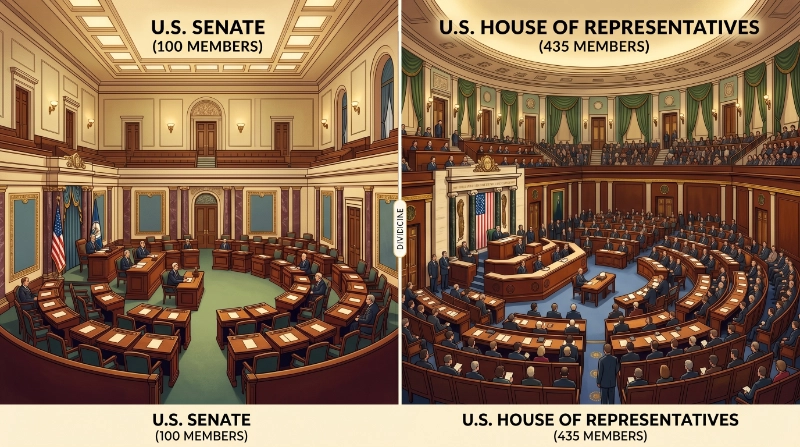
Congress is the legislative branch of the U.S. government and consists of two chambers: the Senate (100 members, 2 from each state, 6-year terms) and the House of Representatives (435 members, based on state population, 2-year terms). Together they make the nation's laws.
Key facts:
- 100 U.S. Senators — 2 per state, 6-year terms
- 435 voting Representatives — based on state population, 2-year terms
- Senate confirms presidential appointments and ratifies treaties
- House originates all spending and tax bills
- Both chambers must pass a bill for it to become law (bicameral)
- The Vice President serves as President of the Senate
Two Chambers, One Congress
The Founders created two chambers as a compromise. Large states wanted representation based on population. Small states wanted equal representation. The solution: give them both.
- The Senate — equal representation. Every state gets 2 senators, regardless of size. California (40 million people) and Wyoming (580,000 people) each have exactly 2 senators.
- The House — proportional representation. States with more people get more representatives. California has 52 representatives. Wyoming has 1.
Together, they form Congress.
The Senate
| Fact | Detail |
|---|---|
| Total members | 100 (2 per state) |
| Term length | 6 years |
| Minimum age | 30 years old |
| Must be a citizen for | At least 9 years |
| Leader | Vice President (President of the Senate) |
| Day-to-day leader | Senate Majority Leader |
Unique powers of the Senate:
- Confirms presidential appointments (Cabinet members, Supreme Court justices, ambassadors)
- Ratifies treaties (requires two-thirds vote)
- Holds impeachment trials (the House impeaches, the Senate decides guilt)
Senators are elected by the entire state. One-third of senators are up for election every 2 years, so the full Senate turns over every 6 years.
The House of Representatives
| Fact | Detail |
|---|---|
| Total voting members | 435 |
| Term length | 2 years |
| Minimum age | 25 years old |
| Must be a citizen for | At least 7 years |
| Leader | Speaker of the House |
Unique powers of the House:
- Starts all revenue (tax) bills — only the House can introduce bills that involve federal spending
- Initiates impeachment proceedings against the President or other officials
- Elects the President if no candidate wins a majority in the Electoral College
Representatives are elected by voters in their specific congressional district, not the whole state. Districts are redrawn every 10 years based on the census.
Who Elects Members of Congress?
The people directly elect every member of Congress, but the process is different for the Senate and the House. Knowing the difference matters for the USCIS civics test — the officer may ask "We elect a U.S. Senator for how many years?" or "We elect a U.S. Representative for how many years?" — and the answer comes from how each chamber is structured.
House of Representatives — elected by congressional district. Each of the 435 voting members is elected by voters in one specific congressional district. The number of districts a state gets depends on its population (counted every 10 years in the U.S. Census), so larger states like California and Texas have many more representatives than smaller states like Wyoming or Vermont. House elections happen every 2 years — every representative is up for election at the same time.
Senate — elected statewide. Each state elects its 2 senators by a statewide popular vote — the same way governors are elected. The candidate with the most votes across the entire state wins. Senate terms are 6 years, and the 100 seats are staggered into three classes so only about one-third of the Senate is up for election in any given election year. That staggering keeps the Senate institutionally stable even when public opinion shifts quickly.
The 17th Amendment changed how senators are elected. Until 1913, U.S. senators were chosen by their state legislatures, not by direct popular vote. The 17th Amendment, ratified in 1913, moved Senate elections to the direct popular vote model that exists today. That amendment is a frequent civics-test reference point.
On the USCIS civics test, the accepted answer to "We elect a U.S. Senator for how many years?" is six (6) and to "We elect a U.S. Representative for how many years?" is two (2).
How a Bill Becomes a Law
- A member of Congress introduces a bill
- The bill is discussed in committee
- The full chamber (Senate or House) debates and votes
- If it passes one chamber, it goes to the other
- Both chambers must pass the same version of the bill
- The bill goes to the President, who can sign it into law or veto it
- Congress can override a veto with a two-thirds vote in both chambers
This process is intentionally slow. The Founders wanted to make sure bad laws were hard to pass.
Senate vs House — Quick Comparison
| | Senate | House | |---|---|
Continue Learning
Frequently Asked Questions
How many U.S. Senators are there?
There are 100 U.S. Senators — two from each of the 50 states. Senators serve 6-year terms.
How many voting members are in the House of Representatives?
The House has 435 voting members. The number of Representatives from each state is based on the state's population — California has the most (52), while several states have only one.
What is the difference between the Senate and the House?
The Senate has 100 members (2 per state, 6-year terms), while the House has 435 members (based on population, 2-year terms). The Senate confirms presidential appointments; the House originates spending bills.
Who is the Speaker of the House?
The Speaker of the House is elected by the members of the House of Representatives and is the leader of the chamber. The Speaker is second in line to the presidency, after the Vice President.
How long are congressional terms?
Senators serve 6-year terms with no limit on re-election. Representatives serve 2-year terms, also with no term limits.
What does Congress do besides making laws?
Congress declares war, approves the federal budget, confirms federal judges and Cabinet officials (Senate), originates revenue bills (House), and has the power to impeach the President.
Is Congress the same as the House and Senate?
Yes — Congress is made up of two chambers (also called houses): the Senate and the House of Representatives. When people say "Congress," they usually mean both chambers together. A bill becomes a law only after both chambers pass it.
Which two houses make up Congress?
The two houses (chambers) of Congress are the Senate and the House of Representatives. This is called a bicameral legislature — "bicameral" means two chambers. Both chambers must agree before a bill can become a law.
What is the difference between a senator, a congressman, and a representative?
A senator is a member of the Senate (each state elects 2). A representative is a member of the House of Representatives (the number per state depends on population). The word congressman (or congresswoman) is sometimes used for either, but more often it specifically means a representative in the House. Technically, both senators and representatives are members of Congress.
Who elects members of Congress?
Members of Congress are elected by the people of each state through direct popular vote. Senators are elected by all the voters of their state. Representatives are elected by the voters of their specific congressional district within a state.
How is representation in the House of Representatives decided?
House representation is based on state population. Larger states get more representatives; smaller states get fewer. The total is fixed at 435 voting members and is reapportioned every 10 years after the U.S. Census. The Senate, by contrast, gives every state exactly 2 senators regardless of population.
Why does the U.S. have two houses of Congress instead of one?
The Founders created two chambers so that small states and large states would both have a fair voice in Congress. The House represents people (more populous states get more seats). The Senate represents states equally (every state gets 2). This compromise — sometimes called the Great Compromise of 1787 — kept both small and large states willing to ratify the Constitution.