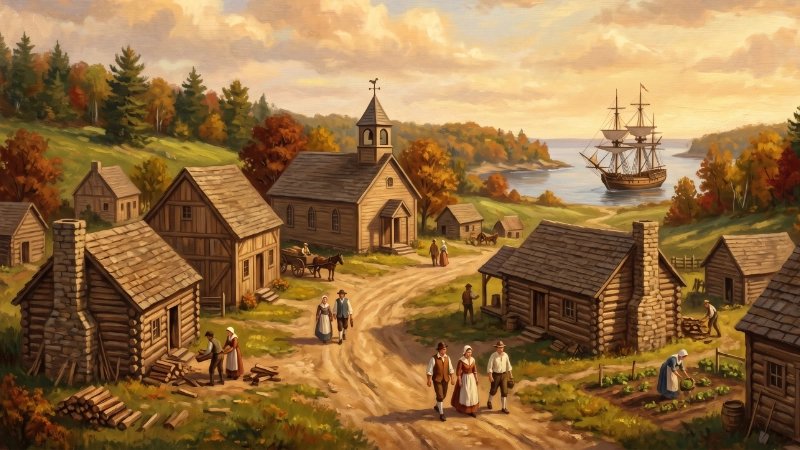
The United States began as 13 British colonies along the eastern coast of North America, founded between 1607 (Jamestown) and 1733 (Georgia). Tensions over taxation without representation led to the American Revolution (1775-1783) and the Declaration of Independence on July 4, 1776.
Key facts:
- 13 original colonies: Virginia, Massachusetts, New Hampshire, Maryland, Connecticut, Rhode Island, Delaware, North Carolina, South Carolina, New York, New Jersey, Pennsylvania, Georgia
- Jamestown (1607) was the first permanent English settlement
- The Pilgrims arrived on the Mayflower at Plymouth in 1620
- Major taxes that triggered revolt: Stamp Act (1765), Tea Act (1773)
- The Boston Tea Party (1773) was a key protest
- Independence declared on July 4, 1776
The First Colonies
The first permanent English settlement was Jamestown, Virginia, established in 1607. The colonists came seeking economic opportunity — gold, trade, and new land.
In 1620, the Pilgrims arrived on the Mayflower and settled in Plymouth, Massachusetts. Unlike the Jamestown settlers, the Pilgrims came for religious freedom — they wanted to practice their faith without persecution from the Church of England.
Over the next 150 years, 13 colonies were established along the Atlantic coast:
New England: Connecticut, Massachusetts, New Hampshire, Rhode Island Middle Colonies: Delaware, New Jersey, New York, Pennsylvania Southern Colonies: Georgia, Maryland, North Carolina, South Carolina, Virginia
Why Did the Colonists Come?
The citizenship test asks this question directly. The main reasons were:
- Freedom — especially religious freedom (Pilgrims, Puritans, Quakers)
- Economic opportunity — farmland, trade, natural resources
- Political liberty — escape from oppressive governments
- Escape from persecution — religious, political, and economic
These motivations are remarkably similar to why immigrants come to America today.
Life Under British Rule
For most of the colonial period, the colonies governed themselves with relative independence. Each colony had its own legislature, and daily life was managed locally.
That changed in the 1760s when Britain, burdened by debt from the French and Indian War, began imposing new taxes on the colonies:
- Stamp Act (1765) — tax on paper documents
- Townshend Acts (1767) — taxes on imported goods like glass, paint, and tea
- Tea Act (1773) — gave the British East India Company a monopoly on tea sales
The colonists objected with a powerful argument: "No taxation without representation." They had no elected members in the British Parliament, so they argued that Parliament had no right to tax them.
The Road to Revolution
Key events that pushed the colonies toward independence:
Boston Massacre (1770) — British soldiers killed 5 colonists during a confrontation in Boston. It became a rallying cry for the independence movement.
Boston Tea Party (1773) — Colonists, disguised as Mohawk Indians, dumped 342 chests of tea into Boston Harbor to protest the Tea Act. Britain responded with harsh punishments.
First Continental Congress (1774) — Representatives from 12 colonies met in Philadelphia to coordinate a response to British policies.
Battles of Lexington and Concord (April 1775) — The first military engagements of the American Revolution. "The shot heard round the world."
Second Continental Congress (1776) — Declared independence and appointed George Washington as Commander of the Continental Army.
The Declaration of Independence
On July 4, 1776, the Continental Congress adopted the Declaration of Independence, written by Thomas Jefferson. It declared that the 13 colonies were free and independent states, no longer under British rule.
The Declaration stated that all people have the right to life, liberty, and the pursuit of happiness, and that governments get their power from the consent of the governed.
The Revolutionary War
The war lasted from 1775 to 1783. Key facts:
- George Washington led the Continental Army
- France was a critical ally — they provided soldiers, money, and naval support
- The turning point was the Battle of Saratoga (1777), which convinced France to enter the war
- The war ended with the British surrender at Yorktown, Virginia (1781)
- The Treaty of Paris (1783) officially recognized American independence
After Independence
After winning independence, the new nation needed a government. The first attempt — the Articles of Confederation — was too weak. So in 1787, delegates met in Philadelphia and wrote the Constitution, which created the government structure that still exists today.
Test Questions About Colonial America
Q: What is one reason colonists came to America? A: Freedom / political liberty / religious freedom / economic opportunity / escape persecution
Q: Who lived in America before the Europeans arrived? A: American Indians / Native Americans
Q: What group of people was taken to America and sold as slaves? A: Africans / people from Africa
Q: Why did the colonists fight the British? A: Because of high taxes (taxation without representation) / because the British army stayed in their houses / because they didn't have self-government
Q: When was the Declaration of Independence adopted? A: July 4, 1776
Q: There were 13 original states. Name three. A: (Any three from: Connecticut, Delaware, Georgia, Maryland, Massachusetts, New Hampshire, New Jersey, New York, North Carolina, Pennsylvania, Rhode Island, South Carolina, Virginia)
Frequently Asked Questions
How many original colonies were there?
There were 13 original colonies along the eastern coast of North America. They became the first 13 states of the United States after independence.
What was the first English settlement in America?
Jamestown, Virginia (1607) was the first permanent English settlement in North America. The colony was founded by the Virginia Company and named after King James I.
Why did the colonists declare independence?
The colonists declared independence due to taxation without representation, restrictions on trade, the housing of British soldiers in colonial homes, and the lack of self-government.
What was the Boston Tea Party?
The Boston Tea Party was a 1773 protest where colonists dumped 342 chests of British tea into Boston Harbor to oppose the Tea Act. It was a major event leading to the American Revolution.
Who fought in the American Revolution?
The 13 American colonies fought against Great Britain (1775-1783). The colonies received support from France, Spain, and the Netherlands. George Washington led the Continental Army to victory.
When did the Revolutionary War end?
The Revolutionary War ended in 1783 with the Treaty of Paris, in which Great Britain officially recognized American independence.
Key Takeaways
- 13 colonies along the Atlantic coast, starting with Jamestown (1607)
- Colonists came for freedom, economic opportunity, and escape from persecution
- "No taxation without representation" — the core argument for independence
- Key events: Boston Tea Party, Lexington and Concord, Declaration of Independence
- George Washington led the army; Thomas Jefferson wrote the Declaration
- France helped America win the war
- Independence recognized by the Treaty of Paris (1783)