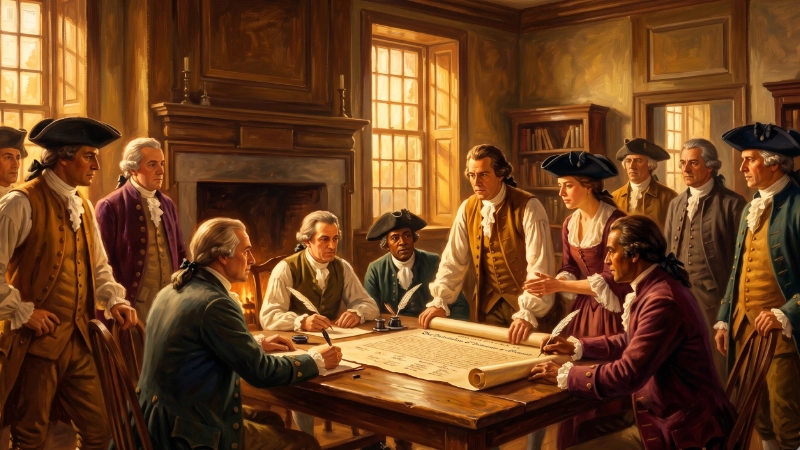
The Declaration of Independence is the document that announced the 13 American colonies' separation from Great Britain on July 4, 1776. Written primarily by Thomas Jefferson, it states that all people have unalienable rights to life, liberty, and the pursuit of happiness. The citizenship test asks several questions about the Declaration — its date, author, and core ideas.
Key facts to remember:
- Adopted on July 4, 1776 — celebrated as Independence Day
- Primary author: Thomas Jefferson
- Signed by 56 delegates of the Continental Congress
- Lists 3 unalienable rights: life, liberty, and the pursuit of happiness
- Declared independence from Great Britain under King George III
What Is the Declaration of Independence?
The Declaration of Independence is a formal statement that announced the 13 American colonies were free from British rule. It was adopted by the Continental Congress on July 4, 1776 — which is why Americans celebrate Independence Day on that date.
It was primarily written by Thomas Jefferson, with input from Benjamin Franklin, John Adams, Roger Sherman, and Robert Livingston. Jefferson was 33 years old at the time.
What Does It Say?
The Declaration has three main parts:
1. The Philosophy — Natural Rights
The most famous section declares that all people have certain rights that no government can take away:
"We hold these truths to be self-evident, that all men are created equal, that they are endowed by their Creator with certain unalienable Rights, that among these are Life, Liberty and the pursuit of Happiness."
These three rights — life, liberty, and the pursuit of happiness — are central to American identity. They come up directly on the citizenship test.
The Declaration also states that governments get their power from the consent of the governed — meaning the people agree to be governed. If a government fails to protect these rights, the people have the right to change or replace it.
2. The Grievances — Why Independence Was Necessary
The longest section is a list of complaints against King George III of Britain. These include:
- Taxing the colonists without their consent ("taxation without representation")
- Keeping standing armies in the colonies during peacetime
- Cutting off trade with other parts of the world
- Dissolving colonial legislatures
- Denying colonists trial by jury
There are 27 grievances in total. They served as a legal argument to the world explaining why the colonies were justified in breaking away.
3. The Declaration — The Actual Break
The final section formally declares that the colonies are free and independent states with the full power to make war, establish trade, and do everything that independent nations do.
Why Does It Still Matter?
The Declaration of Independence established the foundational ideas that the Constitution later put into practice:
- Equality — "all men are created equal" became the moral foundation for ending slavery, extending voting rights, and the civil rights movement
- Natural rights — the idea that rights come from being human, not from the government
- Consent of the governed — the government serves the people, not the other way around
These principles are not just history. They are the values that new citizens are asked to understand and uphold.
The Three Unalienable Rights in the Declaration
The Declaration of Independence names three unalienable rights — rights that belong to every person by virtue of being human and that no legitimate government can take away. The exact words in the document are: "We hold these truths to be self-evident, that all men are created equal, that they are endowed by their Creator with certain unalienable Rights, that among these are Life, Liberty and the pursuit of Happiness."
Life. The first right is the right to live — to not be killed by the government without due process. On the USCIS civics test, "life" is one of the two accepted answers when the officer asks "What are two rights in the Declaration of Independence?"
Liberty. The second right is the right to be free — freedom from arbitrary arrest, freedom of conscience, freedom of movement. "Liberty" is another accepted USCIS test answer to that same question.
The pursuit of Happiness. The third right is the right to seek a meaningful life on your own terms — choosing your work, your home, your faith, your associations. "The pursuit of happiness" is the third accepted answer.
These three rights together form the moral foundation of every other right in U.S. law. The Constitution and Bill of Rights translate these broad principles into specific legal protections — freedom of speech, due process, equal protection — but the Declaration of Independence is where the underlying idea was first stated as a public claim.
The phrase "unalienable" matters: it means these rights cannot be sold, traded away, or revoked. They are not granted by government — they exist before government, and government's legitimate role is to protect them.
Test Questions About the Declaration
Q: What did the Declaration of Independence do? A: Announced our independence (from Great Britain) / declared our independence / said the United States is free
Q: What are two rights in the Declaration of Independence? A: Life / liberty / pursuit of happiness
Q: When was the Declaration of Independence adopted? A: July 4, 1776
Q: Who wrote the Declaration of Independence? A: Thomas Jefferson
Q: When do we celebrate Independence Day? A: July 4
Frequently Asked Questions
When was the Declaration of Independence adopted?
The Declaration of Independence was adopted on July 4, 1776. This date is celebrated every year as Independence Day in the United States.
Who wrote the Declaration of Independence?
Thomas Jefferson was the primary author. The Declaration was reviewed and edited by John Adams and Benjamin Franklin before being approved by the Continental Congress.
What are the unalienable rights mentioned in the Declaration?
The Declaration states that all people have three unalienable rights: life, liberty, and the pursuit of happiness. These rights cannot be taken away by any government.
Who did the United States declare independence from?
The 13 American colonies declared independence from Great Britain, which was ruled by King George III at the time.
What is the difference between the Declaration of Independence and the Constitution?
The Declaration (1776) announced America's separation from Britain and stated principles of liberty. The Constitution (1787) created the framework of the U.S. government — they are two different documents written 11 years apart.
Why does the Declaration of Independence still matter today?
It established the founding principles of American democracy: that government power comes from the people, that all people have equal rights, and that citizens can change a government that fails to protect those rights.
What rights are in the Declaration of Independence?
The Declaration of Independence names three unalienable rights: life, liberty, and the pursuit of happiness. The document argues these rights belong to every person by virtue of being human — they come from being human, not from any government — and no legitimate government can take them away. On the USCIS civics test, "life," "liberty," and "pursuit of happiness" are the accepted answers for the question "What are two rights in the Declaration of Independence?"
What did the Declaration of Independence do?
The Declaration of Independence formally announced that the 13 American colonies were free and independent from Great Britain. It was adopted by the Continental Congress on July 4, 1776. On the USCIS civics test, any of these answers is accepted: "announced our independence," "declared our independence (from Great Britain)," or "said the United States is free (from Great Britain)."
Why is the Declaration of Independence important?
The Declaration of Independence is important because it set out the founding principles of American democracy: that all people are created equal, that everyone has natural rights from birth, and that governments get their power from the consent of the governed. These ideas shaped the U.S. Constitution, the abolition of slavery, the women's suffrage movement, the civil rights movement, and modern American democracy. The Declaration is the reason the United States exists as an independent country.
What rights from the Declaration of Independence apply today?
The three rights from the Declaration of Independence — life, liberty, and the pursuit of happiness — still apply today as the moral foundation of U.S. law. The Constitution and Bill of Rights translate these principles into specific legal protections: freedom of speech, due process, equal protection under the law, and the right to vote. The Declaration is not a law that courts enforce, but its ideas about natural rights and consent of the governed shape how Americans interpret the Constitution.
Key Takeaways
- The Declaration of Independence was adopted on July 4, 1776
- Written by Thomas Jefferson
- It declared the 13 colonies free from British rule
- Three key rights: life, liberty, and the pursuit of happiness
- Government gets its power from the consent of the governed
- It listed 27 grievances against King George III
- Its ideas about equality and natural rights still shape American law and values today