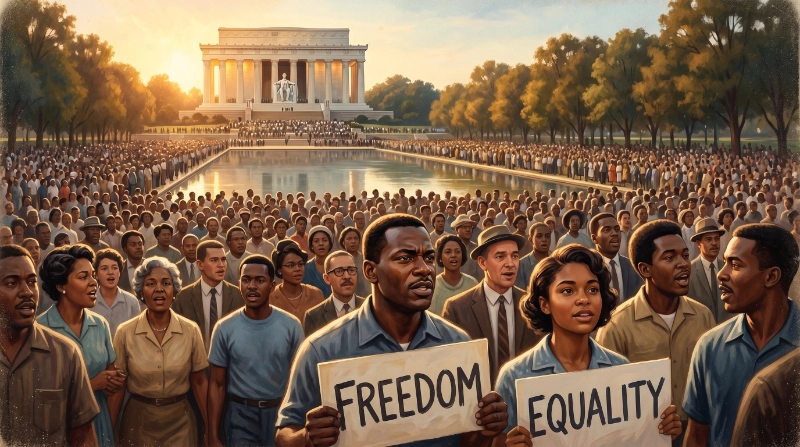
The Civil Rights Movement (1954-1968) was the campaign to end racial segregation and secure equal rights for African Americans. Led by figures like Dr. Martin Luther King Jr., the movement achieved landmark legislation including the Civil Rights Act of 1964 and the Voting Rights Act of 1965.
Key events and figures:
- Brown v. Board of Education (1954) — ended legal school segregation
- Rosa Parks — sparked the Montgomery Bus Boycott in 1955
- Dr. Martin Luther King Jr. — led the movement, gave "I Have a Dream" speech in 1963
- Civil Rights Act of 1964 — banned discrimination in public places and employment
- Voting Rights Act of 1965 — protected Black Americans' right to vote
- March on Washington (August 28, 1963) — 250,000 people gathered for civil rights
What Was the Civil Rights Movement?
The civil rights movement was a broad effort by African Americans and their allies to:
- End racial segregation (separate schools, buses, restaurants, water fountains)
- Secure voting rights that were being denied through intimidation, poll taxes, and literacy tests
- Achieve equal treatment under the law
- End discrimination in housing, employment, and public life
It was a peaceful movement. Its leaders believed in nonviolent protest — marches, sit-ins, boycotts, and civil disobedience — as the most effective way to change unjust laws.
Martin Luther King Jr.
Dr. Martin Luther King Jr. is the most prominent leader of the civil rights movement. The citizenship test specifically asks about him.
Key facts:
- Born January 15, 1929 in Atlanta, Georgia
- Baptist minister and activist
- Led the Montgomery Bus Boycott (1955-1956) — triggered when Rosa Parks refused to give up her seat
- Delivered the "I Have a Dream" speech during the March on Washington (1963)
- Won the Nobel Peace Prize in 1964
- Advocated for nonviolent resistance inspired by Mahatma Gandhi
- Assassinated on April 4, 1968 in Memphis, Tennessee
- His birthday is a federal holiday: Martin Luther King Jr. Day (third Monday in January)
The test asks: "What did Martin Luther King Jr. do?" The answer: He fought for civil rights / worked for equality for all Americans.
Key Events
Brown v. Board of Education (1954)
The Supreme Court ruled that racial segregation in public schools was unconstitutional. This overturned the "separate but equal" doctrine from Plessy v. Ferguson (1896) and was a major legal victory.
Montgomery Bus Boycott (1955-1956)
After Rosa Parks was arrested for refusing to give up her bus seat to a white passenger, the Black community of Montgomery, Alabama boycotted the city bus system for 381 days. The boycott ended when the Supreme Court ruled bus segregation unconstitutional. It launched Martin Luther King Jr. to national prominence.
Sit-Ins (1960)
Students in Greensboro, North Carolina sat at a "whites-only" lunch counter and refused to leave. The sit-in movement spread across the South and led to the desegregation of many businesses.
March on Washington (1963)
Over 250,000 people marched to Washington, D.C. to demand civil rights legislation. This is where King delivered his famous "I Have a Dream" speech on the steps of the Lincoln Memorial.
Selma to Montgomery Marches (1965)
Peaceful marchers were attacked by state troopers on the Edmund Pettus Bridge in Selma, Alabama — an event known as "Bloody Sunday." The violence shocked the nation and helped build support for the Voting Rights Act.
Key Laws
The civil rights movement resulted in landmark legislation:
Civil Rights Act of 1964
- Banned discrimination based on race, color, religion, sex, or national origin
- Outlawed segregation in public places
- Made employment discrimination illegal
- One of the most important laws in American history
Voting Rights Act of 1965
- Eliminated barriers to voting for African Americans
- Banned literacy tests, poll taxes, and other discriminatory practices
- Federal oversight of elections in states with histories of discrimination
- Result: millions of Black Americans registered to vote for the first time
Fair Housing Act of 1968
- Banned discrimination in housing sales, rentals, and financing
- Made it illegal to refuse to sell or rent based on race
Other Important Figures
- Rosa Parks — refused to give up her bus seat, sparking the Montgomery Bus Boycott
- Thurgood Marshall — argued Brown v. Board of Education before the Supreme Court; later became the first African American Supreme Court Justice
- John Lewis — civil rights activist, Freedom Rider, leader of the Selma march, later served in Congress for 33 years
- Malcolm X — advocated for Black empowerment through a different approach than King's nonviolence
Test Questions About Civil Rights
Q: What movement tried to end racial discrimination? A: The civil rights movement
Q: What did Martin Luther King Jr. do? A: Fought for civil rights / worked for equality for all Americans
Q: Name one American Indian tribe in the United States. A: (Various answers — Cherokee, Navajo, Sioux, Apache, etc.)
Frequently Asked Questions
What was the Civil Rights Movement?
The Civil Rights Movement was a campaign from the 1950s and 1960s to end racial segregation and secure equal rights for African Americans. It led to major federal laws banning discrimination.
Who was Martin Luther King Jr.?
Dr. Martin Luther King Jr. was a Baptist minister and the most prominent leader of the Civil Rights Movement. He advocated nonviolent resistance and gave the famous "I Have a Dream" speech in 1963. He was assassinated in 1968.
What did the Civil Rights Act of 1964 do?
The Civil Rights Act of 1964 banned discrimination based on race, color, religion, sex, or national origin in public places, schools, and employment. It was signed by President Lyndon B. Johnson.
Who was Rosa Parks?
Rosa Parks was a civil rights activist who refused to give up her bus seat to a white passenger in Montgomery, Alabama, in 1955. Her arrest sparked the Montgomery Bus Boycott, a key moment in the movement.
What was the March on Washington?
The March on Washington for Jobs and Freedom (August 28, 1963) was a massive rally where about 250,000 people gathered at the Lincoln Memorial. Dr. King delivered his "I Have a Dream" speech at this event.
What movement tried to end racial discrimination?
The Civil Rights Movement worked to end racial discrimination in the United States. Its efforts led to landmark legislation and changed American society.
Key Takeaways
- The civil rights movement fought to end racial segregation and discrimination
- Martin Luther King Jr. was its most prominent leader — fought for civil rights through nonviolent protest
- Key events: Brown v. Board of Education, Montgomery Bus Boycott, March on Washington, Selma marches
- Key laws: Civil Rights Act (1964), Voting Rights Act (1965), Fair Housing Act (1968)
- MLK was assassinated in 1968; his birthday is a federal holiday
- The movement's legacy: equal rights protections that benefit all Americans today