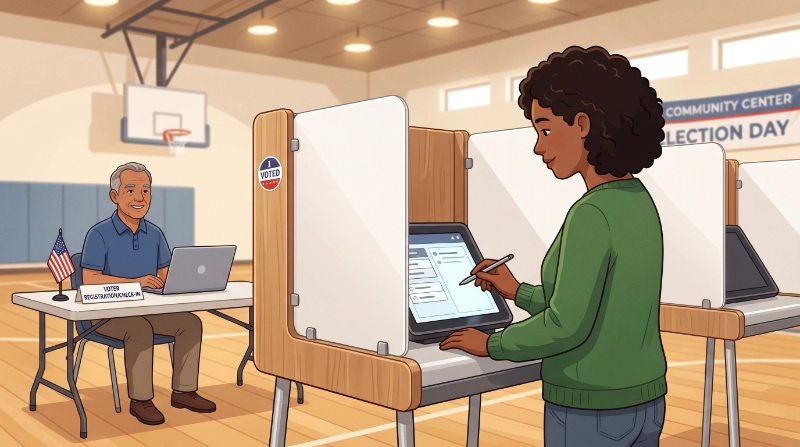
To vote in U.S. elections, you must be a U.S. citizen, at least 18 years old, and registered to vote in your state. Registration deadlines vary by state — most require registration 15-30 days before Election Day. Federal elections happen on the first Tuesday after the first Monday in November.
How to register:
- Online at vote.gov (most states)
- By mail using a National Mail Voter Registration Form
- In person at your state's Department of Motor Vehicles or election office
- During voter registration drives
Voting requirements:
- Be a U.S. citizen (only citizens can vote in federal elections)
- Be 18 or older by Election Day
- Be registered in your state (deadlines vary)
- Bring valid ID where required by state law
Who Can Vote?
To vote in the United States, you must:
- Be a U.S. citizen (naturalized or born in the U.S.)
- Be at least 18 years old on or before Election Day
- Be registered to vote in your state
- Meet your state's residency requirements
Non-citizens — including permanent residents (green card holders) — cannot vote in federal elections. Voting before you are a citizen is illegal and can jeopardize your immigration status.
How to Register
Voter registration varies by state, but generally you can register:
- Online — most states have online registration through their Secretary of State website
- By mail — download and mail a registration form
- In person — at your local election office, DMV, or other government agencies
- On Election Day — some states allow same-day registration
You typically need to provide your name, address, date of birth, and a form of ID (driver's license number or last 4 digits of your Social Security Number).
When Are Elections?
Election Day is the Tuesday after the first Monday in November. This applies to:
- Presidential elections — every 4 years (next: November 2028)
- Congressional elections — every 2 years (all House seats + one-third of Senate seats)
- Midterm elections — congressional elections held between presidential elections
State and local elections may happen on different dates depending on your state.
Many states also offer early voting (in person before Election Day) and absentee/mail-in voting (by mail). Check your state's rules.
What Do You Vote For?
As a citizen, you can vote in elections at every level:
Federal
- President and Vice President — every 4 years
- U.S. Senators — every 6 years (2 per state)
- U.S. Representatives — every 2 years (based on your congressional district)
State
- Governor — leads your state government
- State legislators — members of your state's senate and house
- State judges — in some states, judges are elected
Local
- Mayor and city council
- School board members
- County officials
- Ballot measures — propositions, bond issues, referendums on specific questions
The Electoral College
The President is not elected by direct popular vote. Instead, the United States uses the Electoral College:
- Each state gets a number of electors equal to its total Congressional representation (Senators + Representatives)
- There are 538 total electoral votes (435 House + 100 Senate + 3 for Washington, D.C.)
- A candidate needs 270 electoral votes to win
- In most states, the candidate who wins the popular vote in that state gets all of its electoral votes
This is why presidential campaigns focus on "swing states" — states where the outcome is uncertain.
Political Parties
The United States has a two-party system dominated by:
- The Democratic Party
- The Republican Party
Other parties exist (Libertarian, Green, etc.), but the two major parties win almost all federal elections. You are not required to join a party — you can register as an independent.
The citizenship test may ask:
Q: What are the two major political parties in the United States? A: Democratic and Republican
Other Ways to Participate
Voting is the most direct form of participation, but there are other ways citizens engage in democracy:
- Join a political party or campaign
- Contact your elected officials — call, write, or email them about issues you care about
- Attend town hall meetings or public hearings
- Join a civic organization — groups focused on issues like education, environment, or public safety
- Run for office — any citizen can run for elected positions
- Petition the government — collect signatures to put issues on the ballot
Test Questions About Voting
Q: What is one responsibility that is only for United States citizens? A: Vote in a federal election / serve on a jury
Q: What are two rights only for United States citizens? A: Vote in a federal election / run for federal office
Q: When is the last day you can send in federal income tax forms? A: April 15
Q: What are two ways that Americans can participate in their democracy? A: Vote / join a political party / help with a campaign / join a civic group / write to a newspaper / call Senators and Representatives
Q: What is the name of the current President of the United States? A: (Check current)
Frequently Asked Questions
Who can vote in U.S. federal elections?
Only U.S. citizens age 18 or older can vote in federal elections. Permanent residents and other non-citizens cannot vote in federal, state, or most local elections.
How do I register to vote?
You can register online at vote.gov, by mail using the National Mail Voter Registration Form, or in person at your state's election office or DMV. Registration deadlines vary by state — check your state's deadline on vote.gov.
When are U.S. federal elections held?
Federal elections happen on the first Tuesday after the first Monday in November. Presidential elections occur every 4 years; congressional elections every 2 years.
Do I need ID to vote?
ID requirements vary by state. Some states require photo ID, some accept other forms of identification, and some require no ID for in-person voting. Check your state's specific rules before Election Day.
What if I cannot vote in person on Election Day?
Most states offer absentee voting, mail-in voting, or early voting. You may need to request a ballot in advance — deadlines and rules vary by state.
Can I vote immediately after becoming a citizen?
Yes — once you take the Oath of Allegiance, you become a U.S. citizen with full voting rights. You will need to register to vote in your state to cast a ballot in upcoming elections.
Key Takeaways
- Must be a U.S. citizen, 18+, and registered to vote
- Election Day: Tuesday after the first Monday in November
- President elected every 4 years via the Electoral College (270 to win)
- Senators: 6-year terms; Representatives: 2-year terms
- Two major parties: Democratic and Republican
- Voting is both a right and a responsibility of citizenship
- Many ways to participate beyond voting: campaign, contact officials, run for office