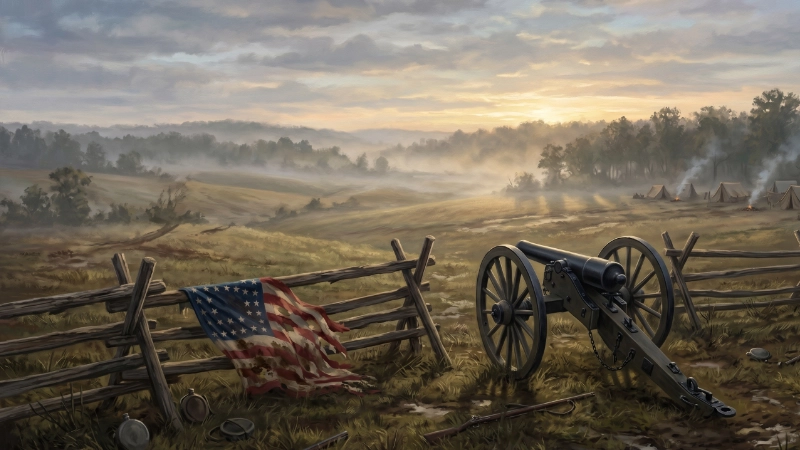
The American Civil War (1861-1865) was fought between the Northern states (Union) and the Southern states (Confederacy) over the issues of slavery and states' rights. The Union won, slavery was abolished, and the United States remained one country. President Abraham Lincoln led the Union throughout the war.
Key facts:
- Fought from 1861 to 1865 (4 years)
- Union (North) vs. Confederacy (South) — 11 Southern states seceded
- Abraham Lincoln was President during the war
- The Emancipation Proclamation (1863) freed slaves in Confederate states
- The 13th Amendment (1865) abolished slavery throughout the U.S.
- War ended on April 9, 1865 when General Lee surrendered at Appomattox
What Caused the Civil War?
The citizenship test asks: "Name one problem that led to the Civil War." The accepted answers are:
- Slavery
- Economic reasons
- States' rights
Slavery
Slavery was the central cause. By the 1860s, the northern states had abolished slavery while the southern states depended on it for their agricultural economy — especially cotton. The moral and political conflict over whether slavery should expand into new territories tore the country apart.
Economic Reasons
The North had an industrial economy based on factories, manufacturing, and wage labor. The South had an agricultural economy built on plantations and slave labor. These fundamentally different systems created opposing interests on trade, tariffs, and labor policy.
States' Rights
Southern states argued that the federal government should not have the power to restrict slavery — that each state should decide for itself. This "states' rights" argument was used to justify secession (leaving the Union).
In reality, these three causes were deeply intertwined. The "states' right" in question was primarily the right to own slaves.
The War
Secession
After Abraham Lincoln was elected President in 1860, 11 southern states seceded (left the Union) and formed the Confederate States of America. They feared Lincoln would restrict or abolish slavery.
Key Facts
- The war lasted from 1861 to 1865
- The Union (North) fought against the Confederacy (South)
- President Lincoln led the Union
- Jefferson Davis was president of the Confederacy
- The war began when Confederate forces attacked Fort Sumter in South Carolina (April 1861)
- It was the deadliest war in American history — over 600,000 soldiers died
Abraham Lincoln
Lincoln is one of the most important Presidents in American history. During the war, he:
- Preserved the Union — kept the country together
- Issued the Emancipation Proclamation (1863) — declared slaves in Confederate states to be free
- Delivered the Gettysburg Address — one of the most famous speeches in American history
- Was assassinated in April 1865, just days after the war ended
The Emancipation Proclamation
On January 1, 1863, Lincoln issued the Emancipation Proclamation, which declared that all enslaved people in Confederate states "shall be then, thenceforward, and forever free."
Important nuances:
- It only applied to states in rebellion (the Confederacy), not border states that stayed in the Union
- It did not immediately free anyone — it took Union military victories to enforce it
- It transformed the war from a fight to preserve the Union into a fight to end slavery
- It allowed African Americans to serve in the Union Army — about 180,000 did
The complete abolition of slavery came with the 13th Amendment in 1865.
After the War — Reconstruction
The period after the Civil War (1865-1877) is called Reconstruction. Three constitutional amendments were passed:
- 13th Amendment (1865) — abolished slavery throughout the entire United States
- 14th Amendment (1868) — granted citizenship to all persons born in the U.S. (including former slaves) and guaranteed equal protection under the law
- 15th Amendment (1870) — gave all male citizens the right to vote regardless of race
These are sometimes called the Reconstruction Amendments and represent some of the most significant changes to the Constitution.
Test Questions About the Civil War
Q: Name one problem that led to the Civil War. A: Slavery / economic reasons / states' rights
Q: What was one important thing that Abraham Lincoln did? A: Freed the slaves (Emancipation Proclamation) / saved (preserved) the Union / led the United States during the Civil War
Q: What did the Emancipation Proclamation do? A: Freed the slaves / freed slaves in the Confederacy / freed slaves in most Southern states
Q: What did the 13th Amendment do? A: Abolished slavery
Q: What did the 14th Amendment do? A: Granted citizenship to all persons born in the U.S. / gave all persons equal protection under the law
Q: What did the 15th Amendment do? A: Gave all male citizens the right to vote regardless of race
Frequently Asked Questions
What was the Civil War?
The Civil War (1861-1865) was a war fought between the Northern states (Union) and the Southern states (Confederacy). It was the deadliest war in American history and ended slavery in the United States.
What caused the Civil War?
The main causes were slavery, states' rights, and economic differences between the industrial North and the agricultural slave-holding South. Eleven Southern states seceded after Abraham Lincoln was elected President in 1860.
Who was President during the Civil War?
Abraham Lincoln was President throughout the Civil War. He led the Union to victory, issued the Emancipation Proclamation, and was assassinated in April 1865, just days after the war ended.
What did the Emancipation Proclamation do?
The Emancipation Proclamation, issued by Lincoln on January 1, 1863, declared that all slaves in Confederate states were free. It did not free slaves in border states that remained in the Union — that came later with the 13th Amendment.
Who won the Civil War?
The Union (Northern states) won the Civil War. General Robert E. Lee surrendered to General Ulysses S. Grant at Appomattox Court House, Virginia, on April 9, 1865.
What was abolished after the Civil War?
Slavery was abolished by the 13th Amendment, ratified in December 1865. The 14th Amendment (1868) granted citizenship to former slaves, and the 15th Amendment (1870) gave Black men the right to vote.
Key Takeaways
- The Civil War (1861-1865) was caused by slavery, economic differences, and states' rights
- 11 southern states seceded to form the Confederacy
- Abraham Lincoln preserved the Union and freed the slaves
- The Emancipation Proclamation (1863) declared slaves in Confederate states free
- The 13th Amendment abolished slavery completely
- The 14th Amendment granted citizenship and equal protection
- The 15th Amendment gave all male citizens the right to vote regardless of race
- Over 600,000 soldiers died — the deadliest war in American history