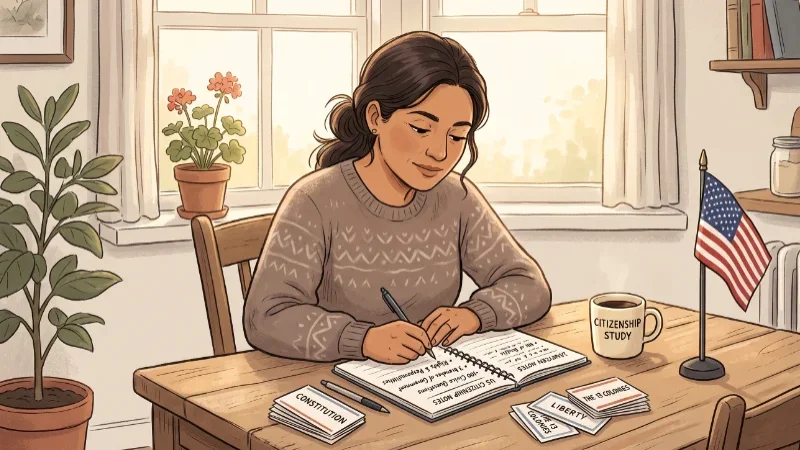
Citizenship test preparation means studying the 128 official USCIS civics questions, practicing them out loud, and rehearsing in the same 10-question, 6-correct format a USCIS officer uses during the naturalization interview. Most applicants need two to six weeks of daily study to feel confident.
Here is what good preparation actually looks like:
- Study material: All 128 official civics questions plus the English reading and writing tasks
- Test format: Spoken — the officer asks, you answer aloud (no multiple choice, no paper)
- Passing threshold: 6 correct out of up to 10 civics questions
- Typical time investment: 15 to 30 minutes per day for 2 to 6 weeks
- What changes: Some answers (current President, your governor, your senators) update over time and need to be re-verified before your interview
This guide walks through every phase of citizenship test preparation, from the first week to the day of your interview. It covers what's on the test, how to structure your study time, common mistakes that trip applicants up, and the practical questions most people ask.
Quick reference
- Questions on the test: 128 official civics questions
- Asked at interview: Up to 10
- To pass: 6 correct
- Test format: Spoken (oral)
- Typical study time: 2 to 6 weeks at 15–30 min/day
- Cost of MyCitizenPrep: $19.95 one payment
What citizenship test preparation actually covers
When most people say "the citizenship test," they mean the civics portion — the questions about U.S. government, history, and symbols. But the USCIS interview tests four things, and good preparation addresses all four:
- Civics test (oral): Up to 10 questions from the official 128. You answer verbally. The officer stops once you reach 6 correct.
- English speaking: Evaluated throughout the interview as you answer questions and have a conversation with the officer.
- English reading: You read one sentence aloud in English.
- English writing: The officer dictates one sentence and you write it down.
The reading and writing portions use simple vocabulary — words like "president," "Congress," "citizen," and "flag." USCIS publishes the full vocabulary lists at uscis.gov. Civics is the part that requires the most preparation, which is why most study tools focus there.
The four-phase preparation plan
You don't need a complicated study system. You need a phased approach that builds knowledge first, then builds recall under pressure.
Phase 1 — Orientation (first week)
Before you start memorizing answers, get the lay of the land:
- Read through all 128 civics questions once. Don't try to memorize anything yet. Just see what's there.
- Group the questions in your head: government structure, history, geography, symbols, holidays.
- Watch a sample interview video on YouTube to see the conversational tone an officer uses.
- Verify the time-sensitive answers (current President, Vice President, your state's governor, your U.S. senators, your U.S. representative). These change. Always check at uscis.gov/citizenship/testupdates before your interview date.
The goal of week one is to lower the unknown. By the end of it, no question on the test should feel like a complete surprise.
Phase 2 — Daily study (weeks 2 through 4)
Pick one of two study schedules and stick to it:
- 15 minutes per day: Plan on 5 to 6 weeks total preparation
- 30 minutes per day: Plan on 3 to 4 weeks total preparation
In each session, do three things in order:
- Learn one new lesson. A "lesson" is roughly 5 to 8 related questions — for example, all the questions about the Bill of Rights, or all the questions about the three branches of government. Read each question and its answer out loud. The test is spoken — your ears and mouth need practice, not just your eyes.
- Review yesterday's lesson. Spaced repetition is the single most effective study technique for memorization. Before starting today's new material, do a quick verbal pass through yesterday's questions.
- Practice five mixed questions. End every session with five randomly mixed questions covering anything you've studied so far. This builds the kind of flexible recall you'll need at the interview, where questions don't come in tidy lesson order.
By the end of week four (or week six on the lighter schedule), you should have covered all 128 questions at least once and reviewed each one multiple times.
Phase 3 — Realistic practice (week 5 or 6)
This is where preparation goes from "I know the answers" to "I can answer under pressure." Switch from learning mode to interview mode:
- Take full 10-question practice tests. Use the same 6-correct-to-pass format the actual test uses.
- Answer aloud. Even when you're alone. Especially when you're alone.
- Time yourself loosely. The real interview moves at conversational pace — about 5 to 10 seconds per answer. If you're freezing for 30 seconds on a question, mark it for review.
- Track your weak questions. Keep a short list of the questions you miss most often. These need extra attention.
- Re-verify time-sensitive answers. The current officials may have changed since you started studying. Check uscis.gov again.
By the end of this phase, you should be passing your practice tests consistently and the questions should feel routine, not nervous.
Phase 4 — Final rehearsal (the week before)
The last week is not for cramming new material. It's for calming nerves and reinforcing what you already know:
- Take one full practice test each day. Aim for 8 or more correct out of 10.
- Read your weak-question list out loud one more time the day before.
- Review the documents you'll bring to the interview (passport, green card, appointment notice, any required tax records).
- Get a good night's sleep. Anxiety hurts recall more than gaps in knowledge do.
- On interview day, eat breakfast, arrive early, and trust your preparation.
How long does citizenship test preparation take?
The honest answer: it depends on three factors.
- Your comfort with English. Native and near-native speakers usually need less time. Applicants still building English fluency often benefit from longer, slower preparation that includes reading and writing practice in addition to civics study.
- How much time you can give each day. Fifteen minutes a day for six weeks beats two hours once a week. Daily repetition is what builds durable recall.
- Your starting knowledge. Some applicants are surprised at how much they already know from years of living in the U.S., watching the news, or helping children with school. Others are starting from zero. Both can pass — they just need different timelines.
A reasonable rule of thumb: start your formal preparation at least one month before your interview date, and ideally six to eight weeks. That gives you time to learn the material at a comfortable pace, work in realistic practice, and have a final calm review week.
What's on the citizenship test in 2026?
Here is what to expect as of early 2026. Always check uscis.gov before your interview for the current format.
- Civics: Up to 10 questions from the official 128-question list, asked verbally. You need 6 correct to pass.
- English reading: You read one sentence aloud. You get up to three sentences total to read at least one correctly.
- English writing: The officer dictates a sentence and you write it. Up to three sentences to write at least one correctly.
- Conversational English: The officer evaluates your speaking ability throughout the interview based on the back-and-forth conversation, not a separate spoken test.
Test format and the question list itself can change. USCIS updated the civics list in 2025, expanding from 100 questions to 128. If you're reading older study materials, double-check that they reflect the current format.
Special cases worth knowing about
Most applicants take the standard test described above, but two situations change what's required. If either of these may apply to you, talk to a licensed immigration attorney or contact USCIS directly — both involve specific eligibility rules and forms.
- The 65/20 rule. Applicants who are 65 or older and have been permanent residents for 20 or more years take a simplified civics test from a smaller subset of about 20 designated questions, and they may take the test in their native language. Read the full breakdown in our 65/20 rule guide.
- Form N-648 (medical disability waiver). Applicants with a physical or developmental disability or mental impairment that prevents them from learning English or the civics material may be eligible for an exception. This requires a licensed medical professional to fill out Form N-648. See our Form N-648 disability waiver guide for the full process.
What to bring to your citizenship interview
Bringing the right documents matters as much as knowing the answers. Plan your interview-day folder around this checklist:
- Your appointment notice (the letter USCIS sent confirming your interview date and location)
- Your green card (Permanent Resident Card)
- A government-issued photo ID — passport, driver's license, or state ID
- All passports you've held during the qualifying residence period (used to verify travel history)
- Any official re-entry permits or refugee travel documents if applicable
- Marriage and divorce certificates if you've married or divorced since filing
- Tax records (transcripts from the past 5 years are commonly requested; 3 years if filing under the spouse-of-U.S.-citizen rule)
- Selective Service registration confirmation if you're a male between 18 and 31 who registered during your time as a permanent resident
- Court records for any arrests or charges, even if dismissed — bring certified records
- Attorney's contact information and a Form G-28 if you're represented by counsel
Arrive at least 30 minutes early. Bring everything in a clearly labeled folder so you can find documents quickly when the officer asks. If you're unsure whether a document applies to you, bring it anyway — it's far easier to have something and not need it than to be missing something USCIS expects.
How the 2026 test compares to the older 2008 test
If you were studying from older materials or know someone who took the test before, here is what changed.
| 2008 Test | 2026 Test | |
|---|---|---|
| Total civics questions | 100 | 128 |
| Questions asked at interview | Up to 10 | Up to 10 |
| Correct answers needed to pass | 6 | 6 |
| Test format | Spoken | Spoken |
| Study materials | M-638 (older) | M-638 updated 2025 |
| Who takes the new test | N/A | All applicants who filed N-400 on or after the rollout date |
The pass threshold did not get harder — you still need 6 correct out of 10. The list got broader, so the variety of possible questions is higher. That makes a structured study plan more important than it was on the older test.
Top mistakes that cause applicants to fail (and how to avoid them)
These are the things that trip applicants up most often. Avoid them:
- Studying silently. The test is verbal. If you only read questions in your head, you'll have a much harder time producing answers out loud under pressure. Always practice aloud.
- Memorizing without understanding. Officers sometimes phrase questions slightly differently than the official wording or ask brief follow-ups. Applicants who memorized exact sentences sometimes freeze when the wording shifts. Applicants who understand the underlying idea answer easily.
- Skipping the time-sensitive questions. Questions about the current President, your governor, your senators, and your U.S. representative all have answers that can change. Verify them within a week of your interview.
- Practicing in the wrong format. (For variety in practice, mix in civics games — short, varied formats that match the real interview's pace.) Hour-long flashcard marathons are not what the test feels like. The test is short, conversational, and varied. Practice in 10-question sets.
- Cramming the day before. Last-minute cramming raises anxiety and rarely fixes gaps. Use the final 24 hours to rest and lightly review, not to learn new material.
- Ignoring the English portion. Some applicants prepare heavily for civics and assume the English parts will take care of themselves. The reading and writing tests have specific vocabulary worth practicing.
How MyCitizenPrep approaches citizenship test preparation
If you want a structured study tool, MyCitizenPrep covers all 128 official civics questions in three modes:
- Learn — Every question with audio playback (the real test is spoken) plus a plain-language explanation of why each answer is correct.
- Practice — Multiple choice rounds organized by lesson, with mastery tracking. Each question can appear in up to five different phrasings, so you learn the underlying idea and not just the exact sentence.
- Quiz — A realistic 10-question, 6-correct simulator using the same format the USCIS officer uses. Take it as many times as you want.
Plus six free citizenship test games (presidents, states, geography, American culture) for the moments you want to step away from civics drills and still be learning.
You can try 10 questions free — no signup, no credit card. Full access is $19.95, one payment.
Sample citizenship test questions
Here are four questions from the official list with answers and brief explanations.
1. What is the supreme law of the land? Answer: the Constitution. Why: The Constitution is the foundational document that creates the federal government and limits its powers. All other U.S. laws must be consistent with it.
2. What do we call the first ten amendments to the Constitution? Answer: the Bill of Rights. Why: The first ten amendments were added in 1791 to protect individual freedoms — speech, religion, the press, assembly, and the right to a fair trial, among others.
3. How many U.S. senators are there? Answer: 100. Why: Each of the 50 states elects two senators, for a total of 100. Senators serve six-year terms.
4. Name one branch or part of the government. Answer: Congress (legislative), the President (executive), or the courts (judicial). Why: The U.S. government is divided into three branches so that no single branch holds all the power. This is the principle of separation of powers.
Quick takeaways
- Citizenship test preparation centers on the 128 official USCIS civics questions, plus the English reading and writing tasks.
- Most applicants need 2 to 6 weeks of daily study (15 to 30 minutes per day) to feel ready.
- The test is spoken, so practice answering aloud — not silently in your head.
- Use a phased approach: orientation, daily study, realistic practice, calm final review.
- Always verify time-sensitive answers (current officials) close to your interview date.
- The USCIS civics list was updated to 128 questions in 2025 — make sure your study material reflects the current version.
Want the focused study plan? This guide covers the full preparation arc end-to-end. For the daily practice routine on its own — what to study each week, how to use audio drills, when to switch from learning mode to quiz mode — see our complete guide to studying for the citizenship test, which breaks down the 4-8 week schedule applicants use to walk into the interview confident.
Not sure which version of the civics test you're preparing for? USCIS now administers two different civics tests depending on your N-400 filing date — the 2008 test (100 questions, 6 of 10 to pass) and the 2025 test (128 questions, 12 of 20 to pass). See our 2025 vs 2008 civics test comparison for the filing-date cutoff rule and how to tell which one applies to you.
Frequently Asked Questions
How long does citizenship test preparation take?
Most applicants need 2 to 6 weeks of daily study, depending on English fluency, time available per day, and prior civics knowledge. A common pattern is 15 to 30 minutes per day for 4 weeks.
How many questions are on the citizenship test?
The official civics list contains 128 questions. During your interview, the USCIS officer asks up to 10 of them and stops as soon as you reach 6 correct answers.
Is the citizenship test multiple choice?
No. The civics test is verbal — the officer asks the question aloud and you answer aloud. There is no multiple choice and no written test for the civics portion. The English reading and writing portions are the only parts that involve writing or reading from a sheet.
What happens if I fail the citizenship test?
USCIS gives applicants a second chance. If you don't pass on your first attempt, you'll typically be scheduled for a re-test within 60 to 90 days. You only need to retake the parts you didn't pass.
Do I need to know all 128 civics questions to pass?
You only need to answer 6 of up to 10 correctly during the interview, so technically you don't need a perfect score on every question. But because the officer can pick from any of the 128, applicants who study all of them have far more confidence and a much higher pass rate.
When should I start preparing for the citizenship test?
Start as soon as you receive your interview notice from USCIS, and ideally even earlier. Most interview notices give 4 to 8 weeks of lead time, which lines up well with the 2-to-6-week study window most applicants need. Starting earlier is fine — there is no penalty for being over-prepared.